
The East Lump

In the misty dawn of a crisp March morning in Venice, Louisiana, a ragtag crew of seasoned fishermen gathered at the docks of Venice Marina. The air was thick with the salty tang of the Gulf of Mexico, mingled with the low rumble of multiple four stroke outboards, and the sound docile chatter of men who lived for the thrill of the open sea.

Venice, a small outpost at the southern tip of Louisiana where the Mississippi River meets the Gulf, has long been a mecca for offshore fishing enthusiasts. Its strategic location provides quick access to some of the most productive waters in the world, teeming with pelagic giants. On this particular day, our group was setting out on what would become a "trip for the books". Their target: the legendary East Lump, a submerged salt dome rising dramatically from the ocean floor, and the prize they sought—a massive yellowfin tuna that would test their skills, endurance, and sheer luck.
Not just any fishing port; Venice is the gateway to the Gulf's bounty. Situated about 75 miles south of New Orleans, this resilient community has weathered hurricanes, oil spills, and economic shifts, yet it remains the epicenter for Louisiana fishing. The town's marinas buzz year-round with charters heading out to rigs, lumps, and canyons where nutrient-rich waters from the Mississippi create a fertile feeding ground for big game fish. Yellowfin tuna, known scientifically as Thunnus albacares, are the stars here. These powerful swimmers, with their sleek, torpedo-shaped bodies and vibrant yellow fins, can reach speeds of up to 50 mph and weights exceeding 400 pounds. In Venice, the average catch hovers between 20 and 60 pounds, but winter months—when cooler waters concentrate the schools—bring in the monsters, often tipping the scales at 200 pounds or more. It's this promise of trophy fish that draws anglers from across the globe, turning routine trips into tales of triumph.
As the sun peeked over the horizon, painting the sky in hues of orange and pink, the crew loaded up their 42-foot Freeman catamaran. The captain, a Venice native whose family has fished these waters for generations, double-checked the gear: heavy-duty rods rigged with 80-pound line, circle hooks baited with chunks of bonito and squid, and an array of lures including poppers and jigs for topwater action. "Winter's the time for the big boys, but they are late this year. We have a good chance today" the captain grunted, his voice carrying the drawl of the bayou. "The East Lump's been hot lately—schools of yellowfin feeding on baitfish pushed up by the upwellings. they migrate here from Africa using the same currents "dat" bring our storms."
The East Lump, a geological marvel, is a small pinnacle in the Gulf's Mineral Prospect 289 (MP289) block, rising abruptly from depths of around 400 feet to just 200 feet. Located about 20 miles east of the Northeast and Octave passes, it's a natural magnet for marine life. Salt domes like this one create irregular bottom structures—scattered live bottom and hard reefs—that attract baitfish, which in turn lure predators like tuna, wahoo, and even the occasional marlin.
The journey out was a 50-mile run southeast from Venice, cutting through the brutal waters of the Gulf. As the boat planed across the waves at 30 knots, the crew "bean bagged it" to pass the time. "You gotta respect the Gulf," the captain spoke said. "One minute it's calm, the next you're in a squall. But the rewards? Worth every wave.... See those breakers ahead. There is a cut thru them and we can save thirty minutes. Nobody is out here "yet" but us anyway"
By mid-morning, the GPS beeped their arrival at the East Lump. The sonar lit up like a Christmas tree—dense schools of baitfish hovering over the rise, with larger shadows lurking below. The captain idled the engines, and the boat drifted into position. "Alright, boys, let's chum 'em," he commanded. Chumming—a technique where anglers toss cut bait into the water to create a chum slick—is a staple for yellowfin in these parts. Soon, the surface boiled with activity as smaller blackfin tuna, skipjacks, and massive hammerhead sharks darted in for the free meal.
The first few hours were a grind. They hooked several respectable yellowfin in the 40- to 60-pound range, their reels screaming as the fish made blistering runs. They landed one after a 20-minute battle, his arms burning from the strain. "These things fight like demons!" one exclaimed, wiping sweat from his brow. But the group knew they were after something bigger. As the sun climbed higher, the wind picked up, whipping the waves into whitecaps with "spaced" swells.
It was around ten o'clock when the big one hit. One main rod, set in a holder at the stern, bent double with a violent jerk. The drag howled as line peeled off the reel at an alarming rate. "Fish on! Big one!" the captain yelled, making room the deck. One man grabbed the rod, planting his feet wide as the tuna surged deep. "Hold on, man—don't let it spool you!" the captain coached from the console. The fight was epic, a true test of men versus pelagic beast. Yellowfin are notorious for their stamina; this one dove repeatedly, trying to shake the hook with powerful head shakes. The man's muscles screamed in protest, but the crew rotated in, offering support and encouragement. "Pump and reel, pump and reel," they urged, patting his fellow pescador on the back.
Two and a half grueling hours later, the fish began to tire. Color flashed in the depths—a golden sickle fin cutting through the blue. "It's a stud! Over 200 easy," the captain estimated. With expert gaff work from the deckhand, they hoisted the massive yellowfin over the side. It thumped onto the deck, its iridescent body gleaming under the sun—a perfect specimen, measuring over 5 feet long. The crew erupted in cheers, high-fives echoing across the water. "Holy shit—that's a personal best for all of us! That might be my personal best as a captain." They gasped, collapsing into the cooler.
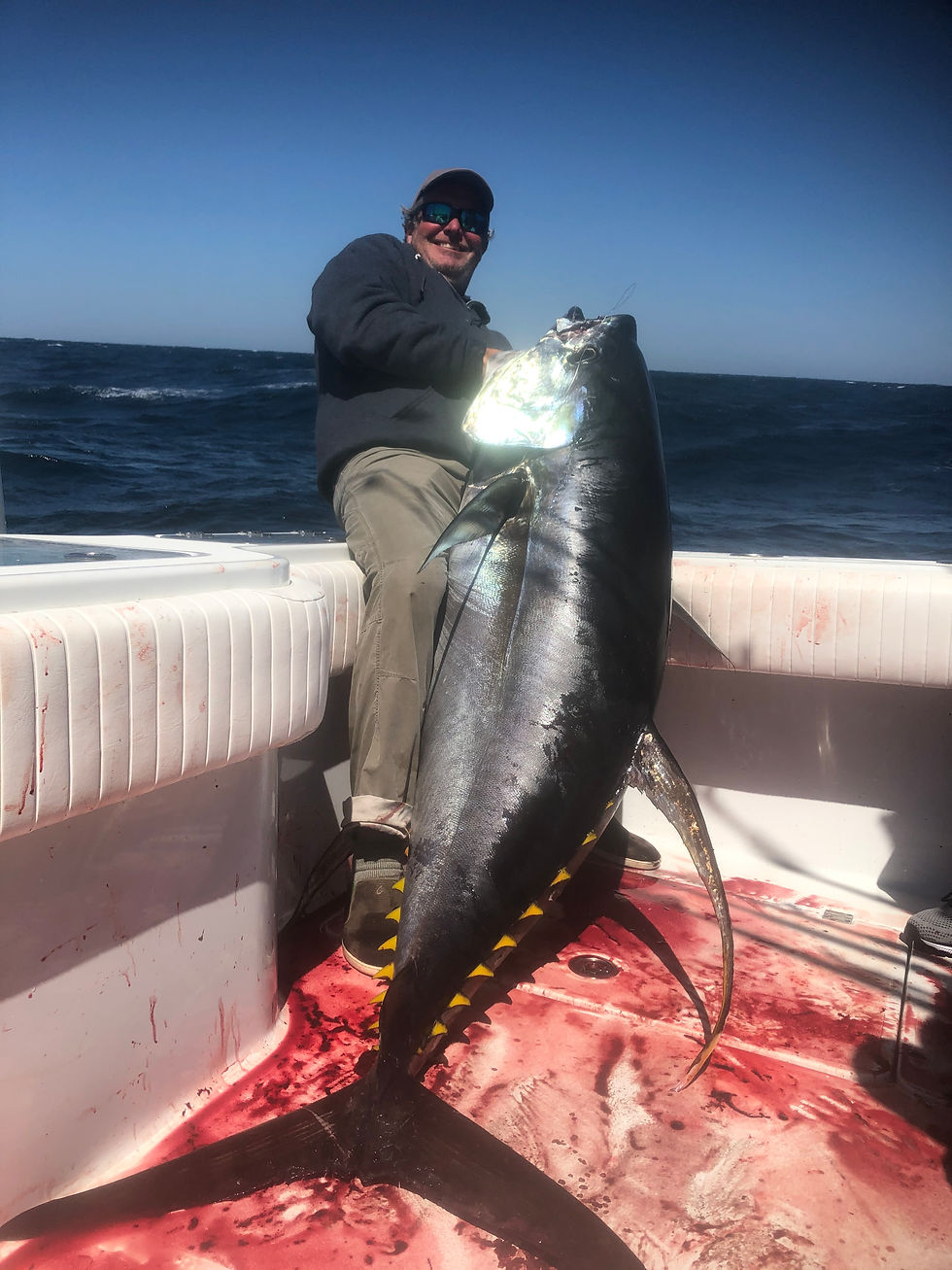
The East Lump's unique bathymetry creates upcurrents that concentrate plankton and bait, drawing in migratory yellowfin from the deeper Gulf. In winter, these fish bulk up on the abundance, preparing for spawning migrations. Venice charters often target such spots, running to oil rigs or lumps like this one, using a mix of trolling, chunking, and jigging. But sustainability is key; regulations from the Gulf of Mexico Fishery Management Council limit bag limits to ensure stocks remain healthy.
As the afternoon waned back at the marina, the group cleaned their catch, filleting the ruby-red meat that would yield sashimi-grade steaks. Yellowfin tuna is prized for its firm texture and rich flavor, often fetching premium prices at markets. Back at the marina that evening, under the glow of string lights, they shared beers and recounted the day's heroics. "That fish fought like it owned the ocean," they said, already planning the next trip. The captain smiled knowingly. "The Gulf gives, but she takes too. Respect her, and she'll reward you. We went where no one else wanted to go today."

This tale from the East Lump underscores why Venice remains a beacon for anglers. In an era of overfishing and climate change, spots like this remind us of the ocean's wild abundance. For the fisherman, that 207-pound yellowfin wasn't just a trophy—it was a bond forged in salt and sweat, a story to pass down through generations. As the sun set over the Mississippi Delta, painting the water in fiery reds, they knew they'd be back. The call of the Gulf is irresistible, and the giants of the East Lump await....


Comments